
Who – I am in my fourth breeding season with Katahdin sheep. I raised feeder lambs as a 4-Her but did not breed so I am fairly new at breeding. I read extensively vet journals and books, consult with more experience shepherds and keep detailed records so I can learn. I wrote these field notes so this knowledge helps me going forward to be a better shepherd. I will warn you they are graphic. Also disclaimer that I am not a vet. I am only four years into breeding. I am not an expert. I am a person who is constantly trying to improve my practices so I can better. While I wrote the notes pragmatically, this was a traumatic experience. I breed my sheep for meat and eat them myself and sell to others but I take my responsibility to treat them well and humanely seriously and care very much for my sheep. This was a difficult thing to do but I feel 100% it was the correct route to treat this ewe humanely and take the knowledge to help my flock going forward.
Ewes –
Ewe #1 with single dead lamb (April) – dam was Greta, sire is Pluto, born 2/22/2023, had single stillborn last spring, 158 pounds
Ewe #2 with twin dead lambs (Alice) – dam was Pickle, Sire was Pluto, born 4/8/2023, first time mom, 123 pounds
(NOTE: I would think perhaps the sire may be the issue except he has fathered at least 100-150 lambs and these are the only two with the issue)
—
Sunday: I had two ewes go in to labor within minutes of eachother. One was laboring and showing contractions. The other had a water bag hanging but no contractions and was moving with the flock and eating and drinking normally. I watched both but the one laboring was not progressing so after about a half hour I went to check and there was a nose sticking out and tongue showing so I knew we had an issue. I lubed up and started pulling and was able to quickly get the two front feet and head out but it did not slip out as expected. After more pulling, I lubed up more and went in deeper to make sure those were the front feet belonging to the head. The area around the neck (I believed to be the neck of the cervix) was tight but passable. After palpating nearly the entire length of the lamb, I determined it was definitely the front feet of the lamb showing. After another half hour or so of pulling I was able to get the lamb out, who was deceased. Ewe was given antibiotic and let loose. She ate and drank. Vulva was swollen but she seemed good and has seemed to be recovering well since. This same ewe is the ONLY ewe I have ever had a stillborn from (she had her first lamb last year who was a large stillborn). This lamb was also a large lamb (approx. 13 pounds). I assumed she had a small cervix and decided she would not be bred again.
At this point I turned my attention to the other ewe. Water bag was now gone and in its place there appeared to be afterbirth with the typical “buttons” seen on a placenta. She was still eating and acting normal with no contractions. I went looking for a lamb that she may have passed. Area was small enough I would have seen it and there was no sign. I had been in the area the entire time working with the other ewe so no chance of walking predator. Did internal exam on her and found her cervix extended some but closed where I could only get two fingers in. Decided to wait and watch and that maybe that was not placenta. She was still acting normally with no contractions at bedtime.
Monday Morning: ewe was still normal and no contractions. Ran to get the hay provided. By lunchtime, she was separating some from the flock, head hanging some and increased respiration. Still bloody residue hanging that looked like typical afterbirth. At 4 pm, did internal and entire vaginal canal was swollen to the point I could not recognize or feel a cervix and I decided that euthanasia was best route. She was euthanized by gunshot to the head and fell immediately with some convulsions. Second shot to be sure. Performed in field c-section. I am not experienced in this, have never seen one done, but decided that a) there was a slight possibility that there may be live lambs b) it was good practice to learn for future situations with little risk of damaging a live animal and c) I could potentially determine why this occurred to prevent future issues.
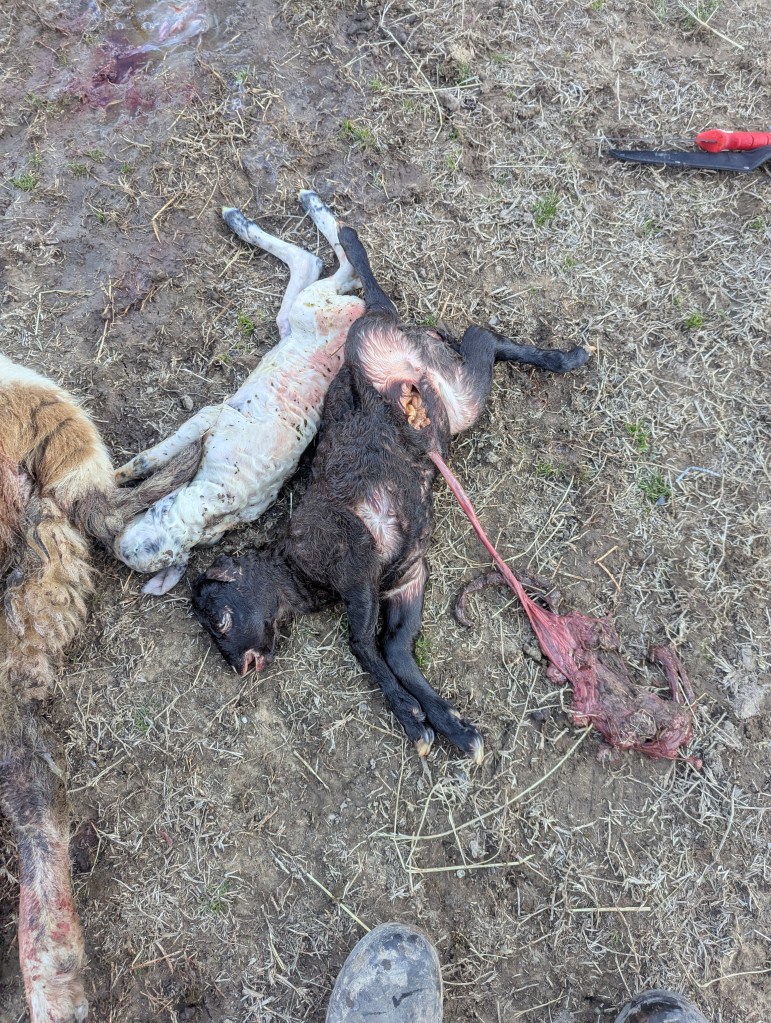
Found two dead lambs. I am not a vet so I may not have been accurate but what I believe I found was:
- One lamb was still in his water bag
- One had lost the amniotic fluid and was “tight” in the bag – it appeared this one was dead longer than the other
- Ewes udder was not fully ready for a lamb. Partially full but nowhere close to what should have been the size.
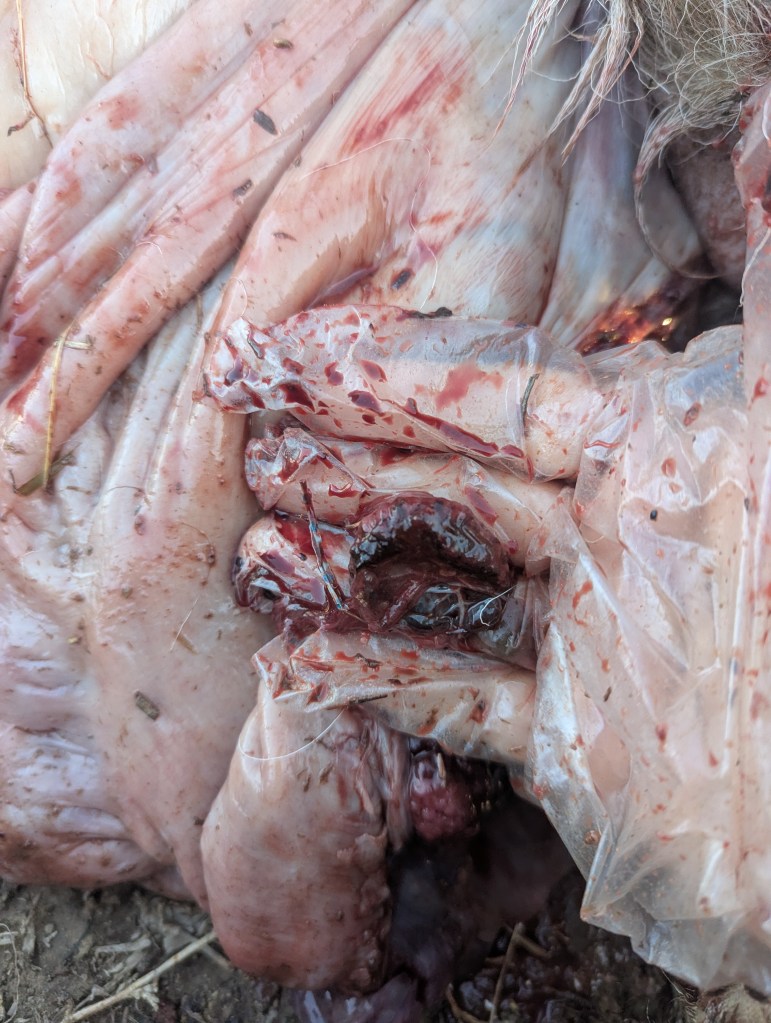
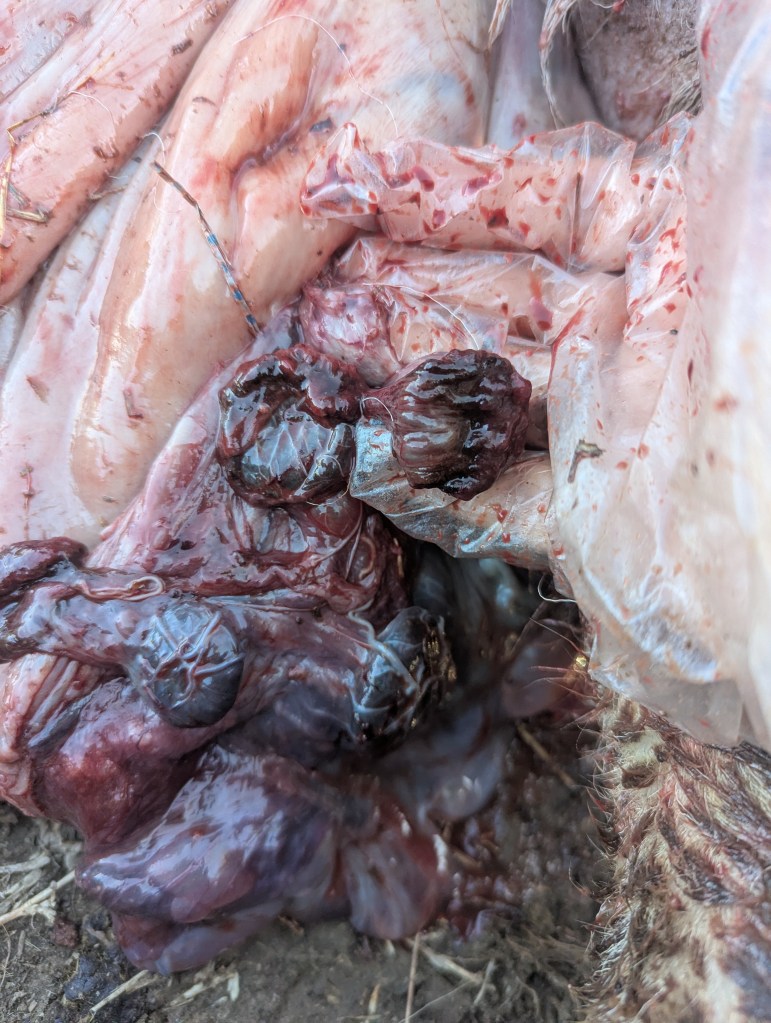
- One placenta was in place and the other was partially through the cervix
- The cervix was open to about four fingers after death. I do not know what is normal for a dead cervix but this seemed small to me. However, there was also swelling that could be making it smaller.
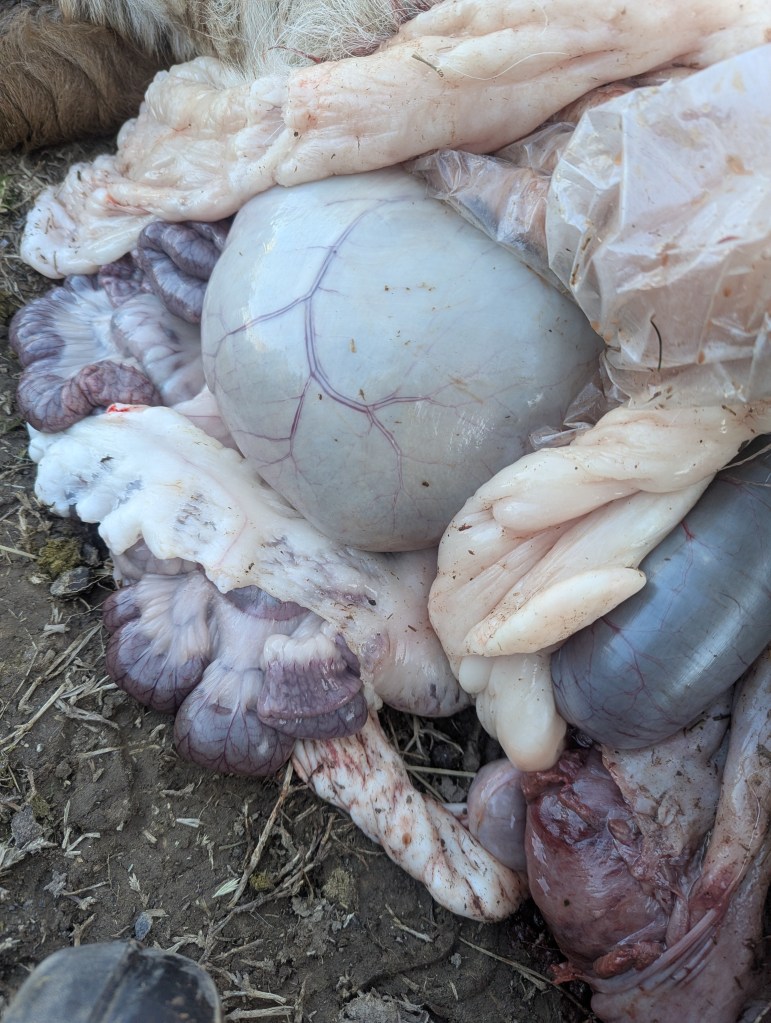
- A uterus and a stomach look very similar. Best way to tell difference besides location is to palpate. A stomach feels like a round, smooth filled ball. A uterus has bumps where the lamb is and is also more oblong.
- Be careful when you slice the uterus as you can damage a potential live lamb. By the time I got to the second lamb I was not being careful as I knew it was dead and “think” I punctured it’s stomach wall but there is a possibility that the lamb had the issue where the intestines form outside the body (you can see that on the black lamb).
- I sliced from udder up towards the heart but if I were in a situation where I was trying to save lambs on a recently euthanized ewe, I would slice horizontally from lower leg to lower leg just above the udder. That would give me a better view of the uterus and not displace other organs that would confuse and get in the way. Cut one layer at a time. Outside hide first and then inner skin and then pull out uterus and VERY carefully slice and open.
- Since I have written the notes the first time I have taken the time to watch videos on c-sections and realize the better method would have been on her side, trimmed the wool/hair, and cut from top to bottom right behind the last rib on her left side. Feel around for legs of lamb and once a small incision is made in uterus, use scissors to cut to prevent cutting lamb. Only a small area is needed to get the lamb out.
Take Aways
- A field necropsy is VERY difficult to do mentally but the knowledge gained is invaluable. Reading about something is not nearly the same as doing.
- A ewe kicks even after being shot. Be careful with your knife as it may kick you (need to find out more about about how to prevent the movement in how we kill… two shots, cut throat? Can they feel or is that just nerves?)
- Two potential ring wombs maybe is just dumb luck or it may be something in my practices. What have I changed? For the first time, I didn’t feed grain in the couple weeks before birthing (I don’t regularly feed grain – only right before and after birth) and instead tried feeding a small amount of alfalfa (two compressed pads per day split amongst twelve ewes) in its place – found some studies that there is more risk of dystocia when ewes were fed alfalfa even though I know that is a common practice. I have removed all alfalfa though as a precaution since I have four more ewes to deliver.
- If you see a water bag and no progress, even if there are no contractions, lube up and go in. If the cervix is tight, begin massaging. Consider whether a chemical “relaxer” would be helpful (need to consult a vet on this one). Get the lambs out naturally if you can. If the cervix won’t dilate, chances are the lambs will die as well as the ewe. May want to consider euthanizing ewe and doing emergency c-section. Vet c-section with sedation may be warranted if there is time, the ewe is not is terrible distress and you think there is a decent chance of survival to go that route.


 Retreat & Learn